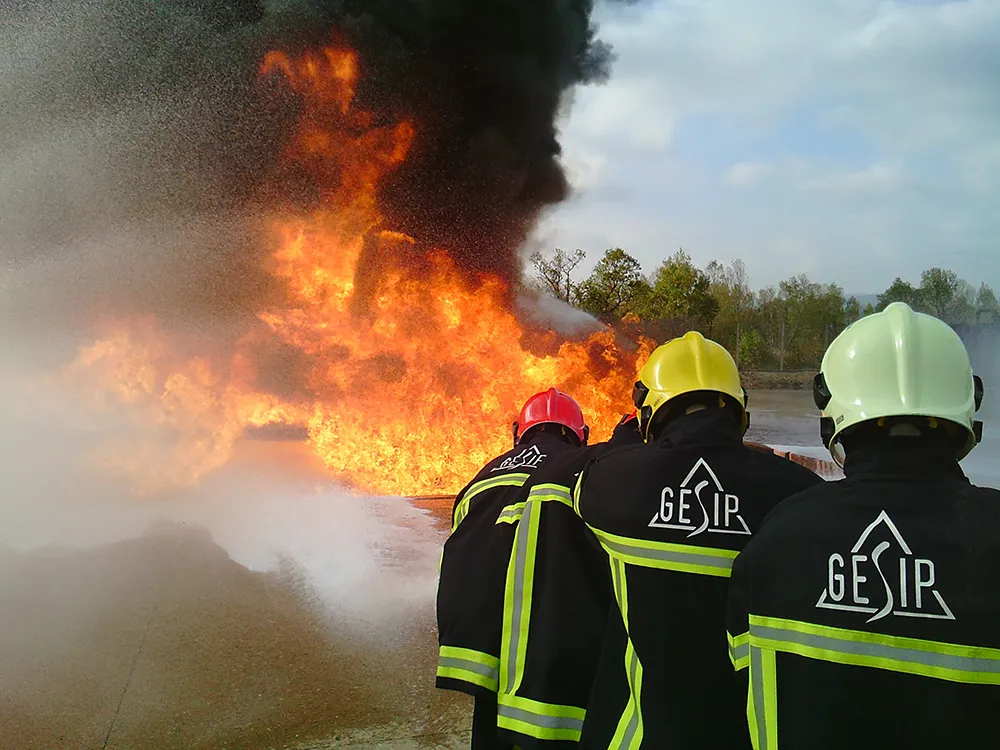
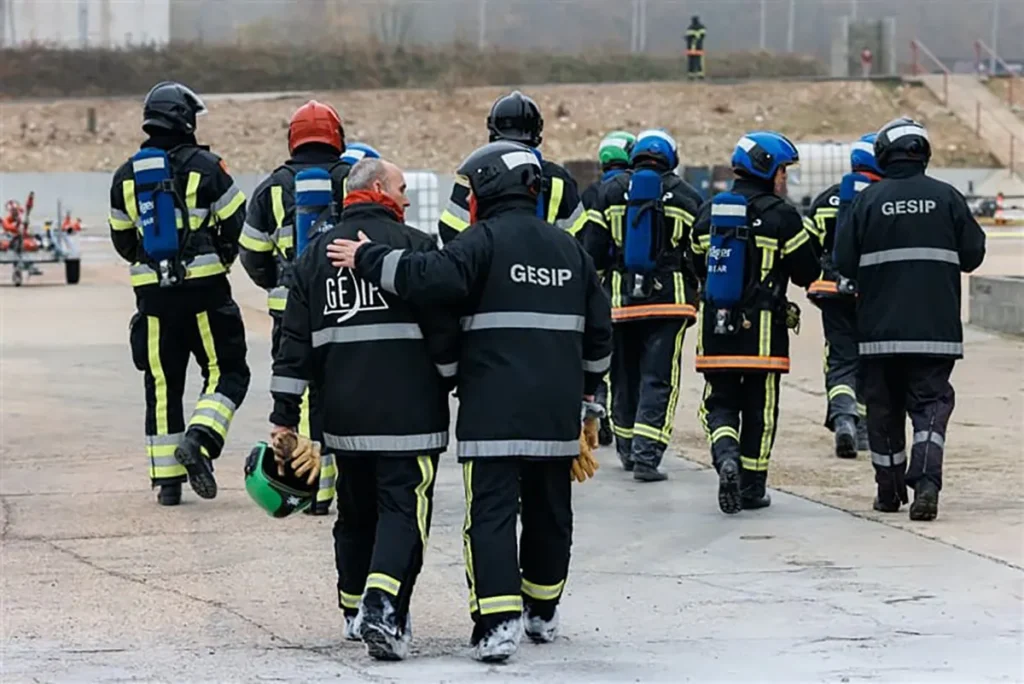
The presence of fluorine in foam concentrates makes the extinguishing foam particularly effective in fighting fires involving flammable liquids, whether water-miscible or not (see “ The Future of Fluorine-Free Foam Concentrates – Episode 1”). Before transitioning to fluorine-free foam concentrates, it is therefore important to verify their effectiveness to ensure that protective equipment and systems at industrial sites are adequate.
In 2023,Gesipundertook to organize and conduct a testing campaign for the latest generation of fluorine-free foam concentrates, modeled after the testing campaigns carried out between 1996 and 2001.
Initial test campaigns and calculated application rates for high-performance emulsifiers
Since the 1990s, Gesip—drawing on its experience in implementing foam concentrates at its industrial site in Vernon—has maintained that the standard extinguishing rates specified in various regulations are higher than the performance levels of the best foam concentrates available on the market.
Between 1996 and 2001, Gesip therefore conducted several test campaigns using foam concentrates available on the market at the time, in order to demonstrate this and have it recognized by government agencies and in regulatory standards.
Grâce aux résultats de ces campagnes, la réglementation française donne désormais la possibilité aux industriels d’utiliser pour certains émulseurs s’avérant particulièrement performants, des inférieurs aux taux forfaitaires – voir aussi « Le taux d’application des émulseurs ».
French regulations, as specified in Annexes 5 and 6 of the amended Order of October 3, 2010, state that, to be considered particularly effective, foam concentrates must have passed qualification tests conducted in accordance with protocols defined in professional guidelines recognized by the Ministry of Sustainable Development.
The test campaigns conducted from 1996 to 2001 involved using each foam concentrate tested at different application rates to extinguishing fires involving flammable liquids (hydrocarbons and alcohols) covering an area of 5.4 m², and then demonstrating the reproducibility of the extinguishing performance on larger areas, up to 200 m².
During these campaigns, film-forming and non-film-forming foam stabilizers were tested using various application methods (gentle and indirect application).
All parameters were carefully recorded: the time it took for 50%, 70%, …, 95%, and 99% of the areas to clear, as well as weather conditions (temperatures, rain, wind, …).
As Gesip had anticipated, the effectiveness of the highest-performing foam concentrates at extinguishing rates lower than the standard rates has been demonstrated.
The results of these campaigns also confirmed, as expected, that the application rate for film-forming foam concentrates was lower (2.0 L/min/m² versus 2.5) than that for non-film-forming foam concentrates.
Le guide Gesip 2012/02 décrit en détail les différents paramètres composant le taux d’extinction pouvant être calculé par chaque industriel utilisant un émulseur « particulièrement performant ».
The 2012/02 guide also includes the protocol developed based on all the data collected during the test campaigns, which has since enabled Gesip to classify foam concentrates as “high-performance.”
by the Ministry of Sustainable Development. It is freely available on the Gesip website, along with the updated list of foam concentrates that have been certified by Gesip.
2023 Test Campaign
Conscients des enjeux sanitaires, environnementaux et des évolutions réglementaires associées, les fabricants d’émulseurs ont développé et commercialisé des émulseurs sans fluor de plus en plus performants.
After observing this improvement during tests conducted at its Vernon facility, Gesip concluded that it was likely that certain fluorine-free (non-film-forming) emulsifiers are now just as effective as fluorinated (film-forming) emulsifiers.
La confirmation de cette hypothèse permettrait aux industriels d’effectuer la transition « émulseurs fluorés vers émulseurs sans fluor » de façon plus sereine, en minimisant les impacts (dimensionnement, …) sur leurs équipements de lutte contre l’incendie,
In early 2023, Gesip, with financial support from 30 of its members, launched a trial campaign for fluorine-free foam concentrates, with the aim of demonstrating that they are now just as effective as film-forming foam concentrates and that they can be used at the same calculated application rates (2.0 L/min/m²).
The campaign ran from April to October 2023, following the same process as previous campaigns:
- A Steering Committee comprising representatives from BRIEC (DGPR), DGSCGC, INERIS, and professional organizations (France Chimie, UFIPEM, SNPAA, USI),
- Tests conducted in accordance with the protocol recognized by the Ministry (Guide 2012/02),
- COPIL members and representatives of funding members may attend the trials,
- Same operational protocol,
The 11 foam concentrates tested were provided free of charge by the suppliers. These were commercially available fluorine-free foam concentrates, which were anonymized upon arrival at the site to ensure the complete impartiality of the results (only Gesip knows the corresponding product names).
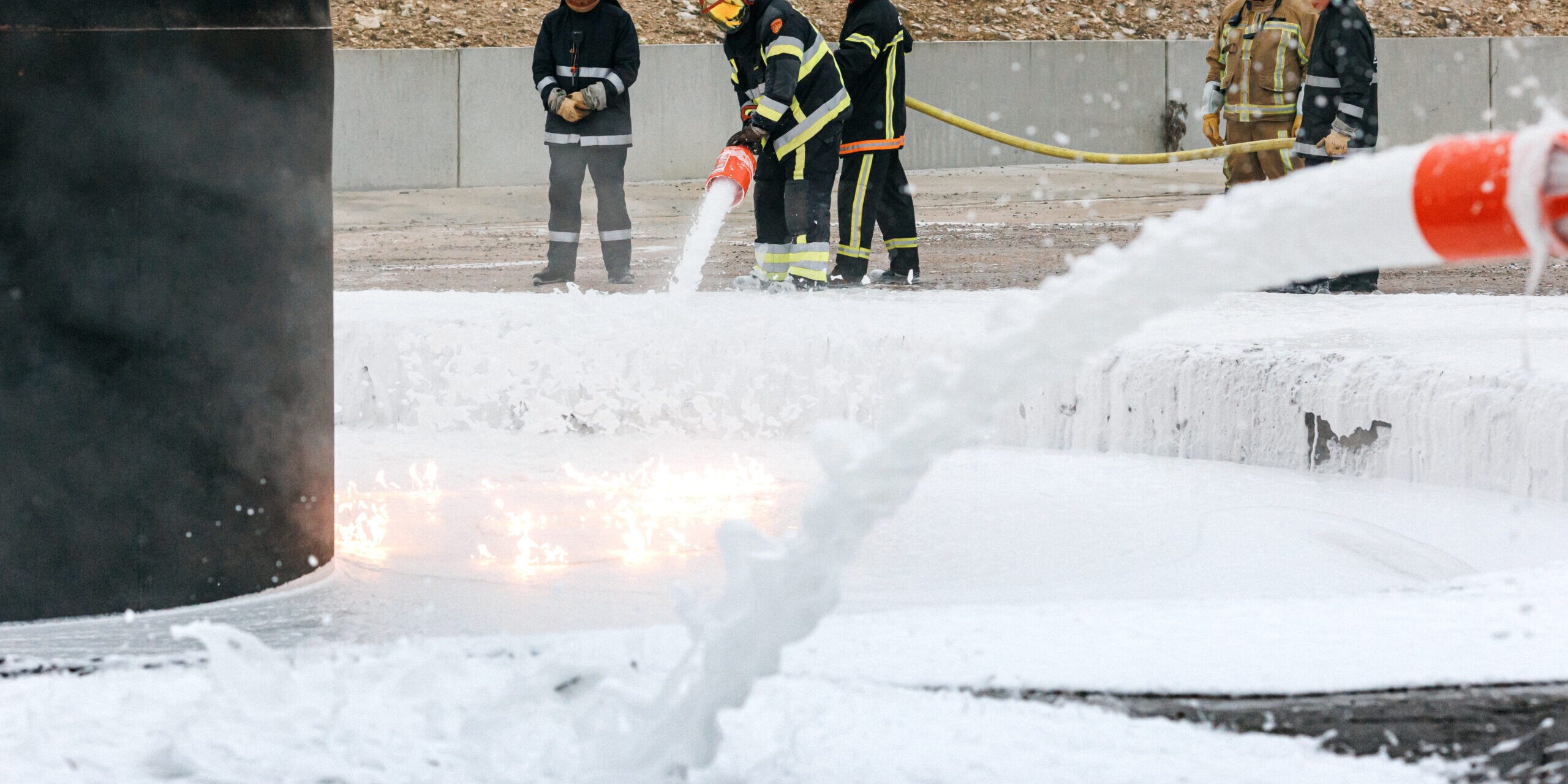
The testing campaign was conducted using gasoline and alcohol, in accordance with the protocol approved by the Ministry. All foam concentrates were tested on a 5.4 m² surface area; the least effective one was then tested on a 45 m² surface area, and finally on a 200 m² surface area.
The results of these tests confirmed that certain new-generation fluorine-free foam concentrates perform as well as film-forming foam concentrates and can therefore be applied at the same calculated application rate (2.0 L/min/m²).
This test campaign also made it possible to verify the high quality of the foam produced, both in terms of its visual appearance and its performance in the re-ignition test.
What happens next?
The Gesip 2012/02 guide has been updated to reflect this change in the rates calculated for
It also provides a precise definition of a fluorine-free foam concentrate:
Fluorine-free foam concentrates are foam concentrates that do not contain added poly- or perfluorinated substances (PFAS) and meet the following requirements:
- la somme des concentrations en PFAS est inférieure à 1 ppm, dans la limite des connaissances actuelles et des méthodes d’analyse et de quantification ;
- by the end of 2023 at the latest, a PFOA concentration of less than 25 ppb and a PFHxS concentration of less than 100 ppb (*).
(*) These thresholds and regulations are subject to change
By definition, a foam concentrate that does not meet these criteria is referred to as a “fluorinated foam concentrate.”
It was recognized on March 21, 2024, by the Ministry of Sustainable Development.
Gesip is continuing to certify fluorine-free foam concentrates at the new calculated rate (based on 2.0 L/min/m²) at the Vernon site.
As soon as the Ministry approves Guide 2012/02, the list of qualified foam agents is updated based on the results obtained in the field.
Afin d’aider les industriels à effectuer leur transition vers les émulseurs sans fluor, Gesip et ses adhérents ont rédigé un document de bonnes pratiques basé sur les expériences de ses adhérents reprenant les différentes étapes à respecter, et soulignant plusieurs points d’attention :
- the need for thorough cleaning of equipment that has come into contact with fluorinated foam concentrates to prevent contamination of new foam concentrates,
- identifying and taking into account any specific physical characteristics of the new foam concentrates (viscosity, etc.)
- the lead times for the new foam concentrates,
- the disposal deadlines for old fire-retardant materials.
This document is intended exclusively for Gesip members.