Since most renewable energy sources are intermittent, storing them is essential for coordinating production and consumption. Furthermore, the growing number of devices operating in a mobile environment has increased the need for energy storage. To adapt to these changes, Gesip has established itself as a leading provider in helping stakeholders better manage the risks associated with industrial energy storage systems.
After describing the various types of energy storage systems, how they work, and their prevalence, we will discuss the risks associated with their installation and with maintenance or repair operations.
Learn more about energy storage systems
The Challenges of Energy Storage Systems (ESS)
Les problématiques de risques et de prévention qui tournent autour du stockage de l’énergie sont un défi tout autant qu’une opportunité majeure pour les industriels, au même titre que l’ensemble de la société, qu’il s’agisse d’assurer les nécessaires transitions écologiques et énergétiques, ou de répondre à des besoins d’autonomie énergétique toujours croissants.
Overview of Energy Storage Systems
An energy storage system is connected to the power grid to smooth out the intermittent output and fluctuations inherent in renewable energy sources.
These systems rely primarily on lithium-ion battery technology. However, there are now various energy storage technologies available:
- Mechanical storage: pumped-storage hydroelectricity (PSH), compressed air energy storage (CAES), and flywheel storage;
- Thermal storage: sensible heat storage, latent heat storage, thermochemical storage, or sorption storage;
- Chemical storage: hydrogen storage, methane storage;
- Electrochemical storage: supercapacitors, electrochemical storage devices (lithium-ion batteries, etc.).
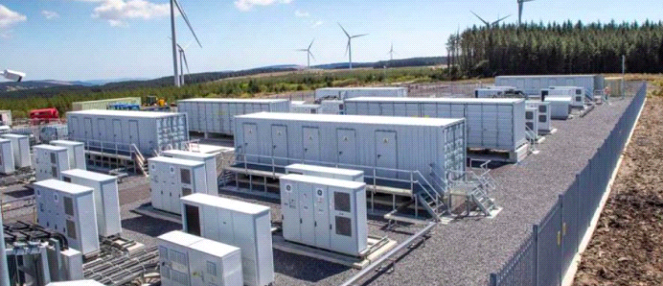
These industrial energy storage systems can be found in a variety of locations:
- Wind farms or solar farms,
- Industrial sites that generate renewable energy,
- Near an RTE power plant, hydroelectric plant…
It is common for ESSs to be installed in multiple containers within the same area at electrical energy storage sites, with standard infrastructure that relies on:
- a high-voltage power line connecting a high-voltage substation to the storage facility,
- a high-voltage/extra-high-voltage electrical substation,
- a set of high-voltage substations,
- a set of containers equipped with inverters that convert the direct current from the batteries into the alternating current of the power grid,
- a set of containers equipped with lithium-ion storage batteries.
Each container contains an array of modules capable of storing a total energy capacity of up to 2.5 MWh at a voltage of 1,000 V DC or 1,500 V DC, depending on the battery type. Each battery module consists of a series-parallel combination of Li-ion cells.
See also:Regulatory Compliance and Industrial Risk Prevention
Industrial energy storage systems: What are the risks?
The various risks specific to the ESS
These systems present significant challenges with containers, as well as risks specific to each type of ESS:
- thermal risks resulting from the ignition of gases during a thermal runaway in a lithium-ion battery;
- electrical hazards resulting from contact with a conductive part;
- toxic risks due to the release of toxic gases when the battery undergoes thermal runaway.
- risk of explosion due to the release of flammable gases during thermal runaway of a lithium-ion battery.
The Safety of ESS
The main safety modules involve connection/disconnection devices located in the control room, which also houses the various battery management components, namely the battery management system (BMS). Depending on the model, ESS units may be equipped with detection systems, fixed or semi-fixed fire suppression systems, or pressure relief vents.
Risks and Prevention in Industrial Energy Storage Systems: Gesip’s Expertise
With over 70 years of experience in the field of industrial risk prevention, our consortium of industrial safety experts has developed a strong track record in risk management.
The combination of accumulated expertise and full-scale infrastructure enables Gesip to offer high-value-added services, including training on industrial energy storage systems, the risks associated with them, and preventive measures to address those risks.
As such, we offer a training course titled “Industrial Energy Storage Systems: Risks and Prevention” designed to ensure that personnel at industrial or logistics sites (operators, EPI, emergency response teams, volunteer firefighters, and industrial firefighters) as well as firefighters from a fire and rescue service to understand the proper procedures to follow in the event of a fire involving an ESS energy storage system, particularly by detailing firefighting and protective measures.