
The traditional scenario in which a single operator manages an entire industrial site is becoming increasingly rare. Economic changes have accelerated the rise of multi-operator sites. This new practice, which is particularly widespread in the chemical industry, creates new challenges in terms of risk management.
Recent examples, such as the fire at Notre Dame de Paris that broke out during construction work, underscore the need to take action to manage industrial risks when operations deviate from standard procedures.
These situations raise the legitimate question of how to manage various operations during major plant shutdowns, construction work, or modernization projects in order to prevent industrial risks.
The Application of General Principles for the Prevention of Industrial Risks
Any approach to industrial risk prevention, including during a shutdown, must always take into account the nine general principles of prevention. These principles, defined by Article L.4121-2 of the Labor Code , provide the framework for the organization of prevention. They are all the more important given that the legislature has transformed the obligation of means into an obligation of results.
- Prevent risks by eliminating hazards and ensuring that personnel and facilities are not exposed to them.
- Assess risks by measuring exposure to hazards, the potential severity of risks, and the level of risk, in order to prioritize preventive measures.
- Address risks at their source by incorporating preventive measures from the initial design of facilities through to the selection and installation of equipment.
- Adapt work to the worker with the aim of reducing the impact of work on employees’ health, particularly with regard to the design of workstations and the selection of work equipment, work methods, and production methods, with a view, in particular, to limiting monotonous work and assembly-line work and reducing their impact on health.
- Take into account technological advancements to adapt the organization of preventive measures.
- Replace hazardous substances or processes with non-hazardous or less hazardous alternatives, avoiding the use of hazardous processes or products whenever the desired result can be achieved by other means.
- Plan preventive measures by taking into account technical aspects, organizational structure, working conditions, labor relations, and the influence of environmental factors.
- Prioritize collective protective measures over individual protective measures, which should only be used if they are deemed necessary.
- Donner les instructions appropriées aux personnels grâce à des formations et des informations adaptées et actualisées afin qu’ils maîtrisent les différents risques et les mesures de prévention mises en œuvre.
Adaptation
Preventing industrial risks during a plant shutdown requires careful planning in advance, based on a risk analysis process. This method has proven effective in many fields: HAZOP / FMEA / ARP / PdP / AT / …
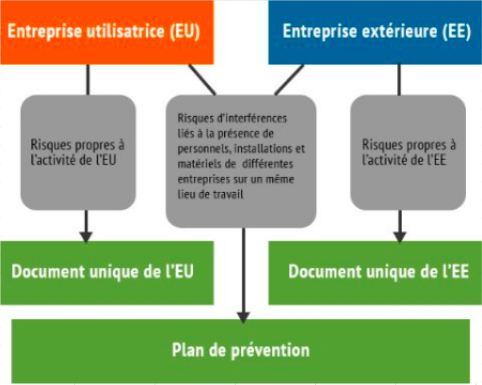
Construction work or the logistics associated with major operational shutdowns give rise to new risks. It is therefore essential to identify, as comprehensively as possible, the hazards and risks that are created or encountered, particularly those caused by interactions between the host company and external contractors.
This analysis should lead to the implementation of organizational and logistical measures designed to better manage risks, particularly by placing qualified personnel in key positions. This organizational structure must necessarily be accompanied by controls and audits that may result in corrective actions, the implementation of which must be carefully monitored.